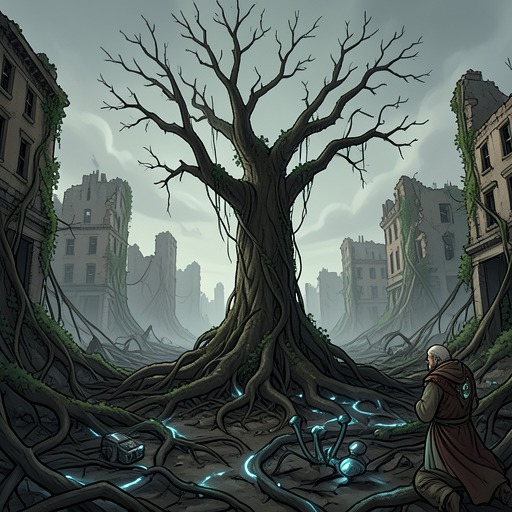
Ideation of dying
Chasing SunlightIdeation of dying is the central affliction imposed by the deserted city: an invasive compulsion that turns the desire for death into an immediate, almost sensuous imperative. It is not death itself, and not life either, but a threshold experience fixed on the final instant before oblivion. The city’s presence is therefore less a visible monster than an atmosphere of ravenous dying, one that converts memory, architecture, and bodily impulse into invitations to cross the last boundary.
Nature and Manifestation
The inhabitant of the deserted city has no visible or audible form, no flesh and no shadow. It exists as a raw force of lonely longing and sharp nostalgia for the moment of dying, carrying tender impressions of life draining away into nothingness. These emotions and images strike the visitors with such force that everyone staggers except the two Lux Guards. The state spreads through sensation before it can be understood: the body receives the desire first, while reason struggles to identify the impulse as alien.
Jonathan Heights is not protected by the sunlight that fills him. The compulsion finds purchase in everything—flesh, stone, and insubstantial dreams—and drives him toward his own death with frightening specificity. He grips his cane until his knuckles whiten while resisting the urge to use it against his throat or smash his head against the stone. The temptation is not framed as ordinary despair; it presents self-destruction as a route to an exquisite final instant, making the approach of death feel like the object of desire rather than the end of it.
The City as an Instrument of Compulsion
Once the group begins its retreat, the city’s ordinary geometry becomes inseparable from Ideation of dying. Every corner appears sharpened for cutting a wrist or throat, every street edge seems designed to trip a traveler into a broken neck, and every hard surface offers a place to dash open a skull. The streets remain, in physical terms, merely streets, but perception turns them into an abyss of knives. This transformation makes the environment itself complicit in the compulsion: the city does not need to seize its victims when it can make every step appear to contain an opportunity for injury.
The distortion intensifies as the escape continues. Ordinary sounds become imagined preparations for death—the drawing of Jonathan’s blade, Eleanor McAvey’s dagger leaving its sheath, or the click of a zint-pistol being primed. Streets and buildings cease to connect in the expected order, while each intersection alters as though the city were rearranging its internal structure. Corners multiply, street edges become jagged, and even a distant curb produces a real cut across Jonathan’s cheek after his perception has already been saturated with threats. The state thus operates through a disturbing overlap of false invitation and genuine danger: the imagined violence is unreal, but the resulting confusion can still produce physical harm.
Resistance and Escape
The compulsion also attacks the will to continue. During the passage through a damaged shortcut, every opening becomes a gate to oblivion and every remaining light seems capable of cutting, burning, or severing. Jonathan understands that these dangers are perceptions, yet the emotion and desire to fail wash over the group with enough force to nearly make failure happen. Ideation of dying is consequently both hallucination and pressure: it does not merely show the characters ways to die, but urges their bodies to enact the vision.
Jonathan resists by loosening his control and allowing the presence of sunlight to rise through him. Under its dominion, the city’s suggestions lose their power to take hold, but the defense carries its own danger. If he surrenders too completely to sunlight, he may lose awareness of the individual steps required to reach safety and lose himself in the force that protects him. His survival depends on maintaining an unstable distinction between using sunlight and being consumed by it.
The escape is collective as well as inward. Antomine remains the least affected, though the light in his eyes reveals that he too is under pressure. He leads the return through the altered streets, while Jonathan stays near enough to correct his course. When Antomine falters, Jonathan lifts him and continues running, carrying the inquisitor despite his own exposure. Eleanor, meanwhile, is sent ahead with Antomine’s guards and their burdens. Ideation of dying isolates each person inside a private desire, but the movement out of the city requires bodies to support one another before the city can make that desire decisive.
Threshold Meaning
The state belongs to a wider pattern of dangerous threshold spaces in which ordinary rules are suspended or rewritten. The Endeavor reaches an impossible settlement in the wilderness, encounters the power-based order of Ukaresh, passes through the Dead Battle where spectacle gradually becomes an approach, and emerges from the Arch of Khokorron into the Lofted Lakes through an aperture far smaller than the monument itself. Against these other liminal environments, the deserted city is distinguished by its assault on the boundary between thought and action: a passing image of death becomes an apparent command, and architecture becomes an extension of inward collapse.
Its deepest contrast appears later at Bright Defile. There, sunlight is defined by the absence of secrets and by a final barrier that can be crossed only when every remaining shadow is shed. In the deserted city, the desire to die offers an immediate escape from the self; at Bright Defile, crossing requires Jonathan Heights to relinquish the accumulated structures of that self deliberately, including his estate, his connections, his books, his friendship with Eleanor McAvey, his banishment from Ukaresh, and the consequences of earlier catastrophes. Ideation of dying therefore dramatizes the involuntary, ravenous version of dissolution, while the final barrier presents sacrifice as a conscious passage. Together they distinguish being pulled toward oblivion from choosing what must be surrendered in order to proceed.
Consequences for the Expedition
Ideation of dying leaves the expedition with more than an episode of terror to survive. Its influence makes the deserted city a hostile participant in the journey, capable of turning a necessary retreat into a struggle against the travelers’ own perceptions and impulses. Even the recovery of the stolen luminiferous gems is overshadowed by the need to escape before the city’s pressure overwhelms them. The saboteur’s death does not satisfy the presence; it merely whets its appetite, demonstrating that the city’s hunger is not attached to one victim or one act but seeks continued surrender from everyone within its reach.
The compulsion also exposes the limits of the protections surrounding the Endeavor. The ship itself remains safe for a time because of the plaque Antomine has provided, but that protection does not extend indefinitely or shield the people moving through the city. Jonathan recognizes that the plaque will eventually have to be removed, risking permanent damage if the expedition remains too long. The distinction is crucial: safety can be assigned to an object or bounded space, while Ideation of dying penetrates bodies, thoughts, routes, and meanings. The group cannot simply wait for the danger to pass; it must cross the city while the protection still holds and while its members retain enough agency to act.
The state’s most unsettling consequence is its conversion of cooperation into a form of resistance. Jonathan’s cane, ordinarily a support and a concealed weapon, becomes the means by which he denies both the city’s invitations and his own surrender, first grounding his perceptions with a sharp strike against the stone and later helping Antomine continue when the inquisitor falters. Eleanor’s dagger and the zint-pistol likewise cease to be neutral equipment: under the city’s influence, every weapon and every edge becomes part of an imagined route toward the final instant of dying. The expedition survives not by eliminating the desire, which remains present, but by recognizing its foreign source, preserving movement, and carrying the vulnerable until the altered streets can be left behind.
Threshold Meaning
Ideation of dying belongs to a wider pattern of dangerous threshold spaces in which ordinary rules are suspended or rewritten. The Endeavor reaches an impossible settlement in the wilderness, encounters the power-based order of Ukaresh, passes through the Dead Battle where spectacle gradually becomes an approach, and emerges from the Arch of Khokorron into the Lofted Lakes through an aperture far smaller than the monument itself. Against these other liminal environments, the deserted city is distinguished by its assault on the boundary between thought and action: a passing image of death becomes an apparent command, and architecture becomes an extension of inward collapse.
Its deepest contrast appears later at Bright Defile. There, sunlight is defined by the absence of secrets and by a final barrier that can be crossed only when every remaining shadow is shed. In the deserted city, the desire to die offers an immediate escape from the self; at Bright Defile, crossing requires Jonathan Heights to relinquish the accumulated structures of that self deliberately, including his estate, his connections, his books, his friendship with Eleanor McAvey, his banishment from Ukaresh, and the consequences of earlier catastrophes. Ideation of dying therefore dramatizes the involuntary, ravenous version of dissolution, while the final barrier presents sacrifice as a conscious passage. Together they distinguish being pulled toward oblivion from choosing what must be surrendered in order to proceed.
Consequences for the Expedition
Ideation of dying leaves the expedition with more than an episode of terror to survive. Its influence makes the deserted city a hostile participant in the journey, capable of turning a necessary retreat into a struggle against the travelers’ own perceptions and impulses. Even the recovery of the stolen luminiferous gems is overshadowed by the need to escape before the city’s pressure overwhelms them. The saboteur’s death does not satisfy the presence; it merely whets its appetite, demonstrating that the city’s hunger is not attached to one victim or one act but seeks continued surrender from everyone within its reach.
The compulsion also exposes the limits of the protections surrounding the Endeavor. The ship itself remains safe for a time because of the plaque Antomine has provided, but that protection does not extend indefinitely or shield the people moving through the city. Jonathan Heights recognizes that the plaque will eventually have to be removed, risking permanent damage if the expedition remains too long. The distinction is crucial: safety can be assigned to an object or bounded space, while Ideation of dying penetrates bodies, thoughts, routes, and meanings. The group cannot simply wait for the danger to pass; it must cross the city while the protection still holds and while its members retain enough agency to act.
The state’s most unsettling consequence is its conversion of cooperation into a form of resistance. Jonathan’s cane, ordinarily a support and a concealed weapon, becomes the means by which he denies both the city’s invitations and his own surrender, first grounding his perceptions with a sharp strike against the stone and later helping Antomine continue when the inquisitor falters. Eleanor McAvey’s dagger and the zint-pistol likewise cease to be neutral equipment: under the city’s influence, every weapon and every edge becomes part of an imagined route toward the final instant of dying. The expedition survives not by eliminating the desire, which remains present, but by recognizing its foreign source, preserving movement, and carrying the vulnerable until the altered streets can be left behind.